Current at 2 October 2026
Tasmania’s fuel supply is secure
We know people are concerned, but Tasmania continues to receive regular fuel deliveries through the national supply chain as normal.
While the State's fuel supply remains secure, with regular deliveries continuing through the national supply chain, we recognise that Tasmanians are experiencing the flow-on effects of higher fuel prices.
We’re working closely with fuel suppliers, industry and other stakeholders to monitor the situation and to keep fuel moving to where it is needed
Latest Updates
Tasmania fuel supply snapshot
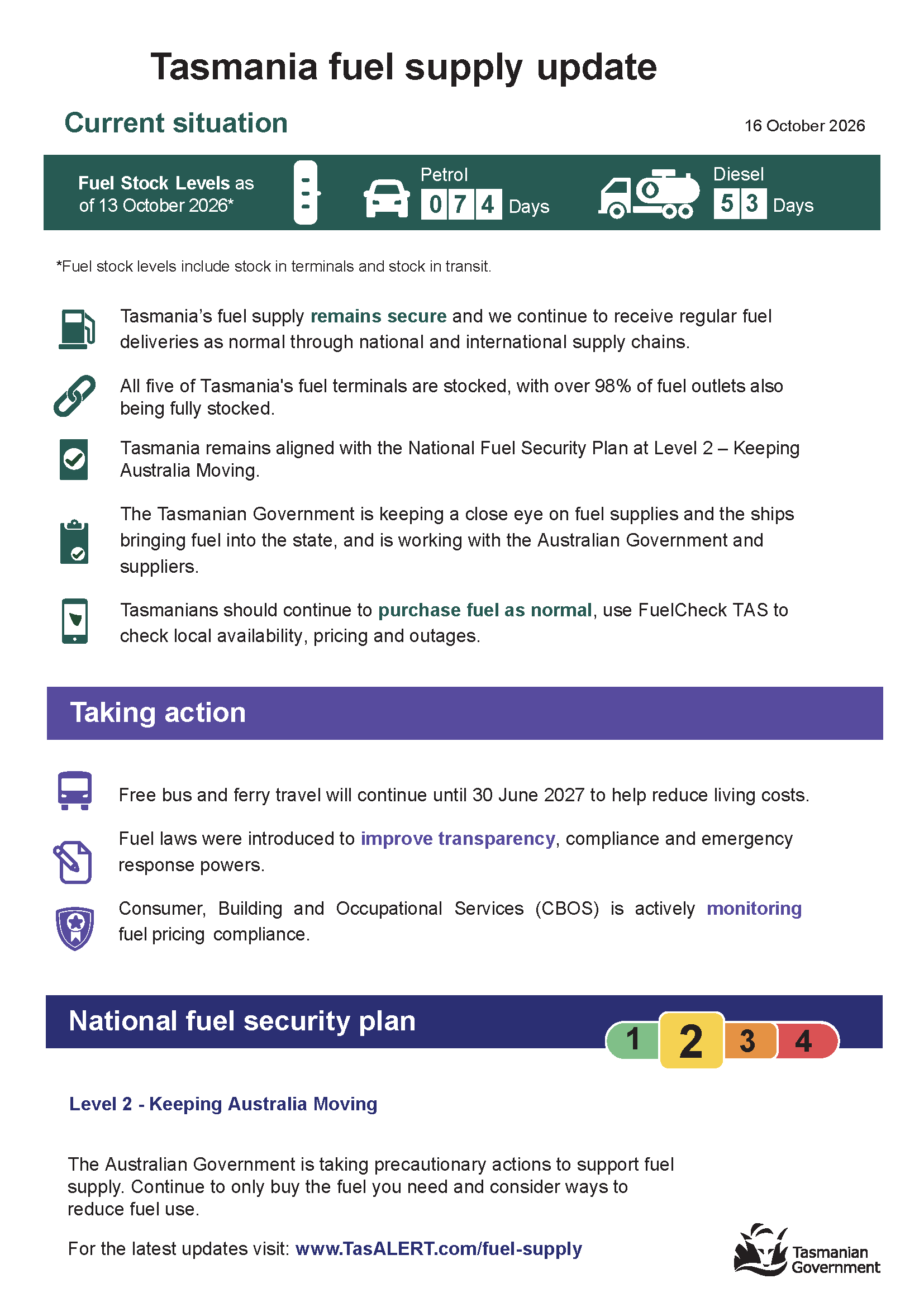
This update is based on the Director Energy Planning's weekly fuel supply update.
What is the Tasmanian Government doing?
The Tasmanian Government is taking action to respond to global conflicts which are creating uncertainty locally.
The State is working with the Federal Government to ensure Tasmania's fuel supply remains secure.
Tasmania Fuel Security Plan
The Tasmania Fuel Security Plan reinforces a clear and staged approach to managing fuel supply and is aligned to the National Fuel Security Plan.
Tasmania remains at Level 2, Keeping Tasmania Moving.
Free bus and ferry travel from 30 March 2026 to 30 June 2027
Public transport is free from Monday, 30 March 2026 to Tuesday, 30 June 2027.
Free travel applies to
- adult, concession, urban, non-urban, and child/student fares
- general access services operated by Metro Tasmania, Tassielink Transit, Kinetic, Manions Coaches, Calows Coaches, Area Connect, and Derwent Ferries
- all government contracted school bus services that charge a fare.
The Tasmanian Government has introduced this temporary measure in response to rising fuel costs. Public transport is a great alternative to driving for many people, and this incentive encourages people to give it a go. Instead of paying for petrol and parking, you can try the bus or ferry for free.
The Petroleum Report (Miscellaneous Amendments) Bill 2026
On Thursday 27 March, The Petroleum Report (Miscellaneous Amendments) Bill 2026 was passed by the Tasmanian Parliament. These new laws will improve transparency, strengthen compliance and enhance Tasmania’s ability to act during fuel disruptions.
The Petroleum Report (Miscellaneous Amendments) Bill 2026 will:
- Enforce clearer rules for fuel companies to report on supply levels.
- Strengthen emergency powers so that emergency restrictions periods can be extended if required.
- Enable the Government to temporarily set maximum fuel prices.
Support for Food Relief Services
The Tasmanian Government delivered an additional $500,000 for food relief services. This funding was delivered as one-off funding that has been allocated specifically to assist distribution of food relief.
The funding has now been allocated to organisations across Tasmania.
Director of Energy Planning Update
Tasmania's Director of Energy Planning is providing regular fuel supply updates.
For the latest update, visit the Fuel supply update for Tasmania website.
What is the Australian Government doing?
Emergency Competition law changes
The Australian Government has introduced emergency competition law changes:
- New legislation now allows the ACCC to fast-track competition law exemptions during national emergencies and exceptional circumstances.
- The changes will allow businesses to coordinate more quickly to support essential supply chains and services during crises, while maintaining safeguards to minimise impacts on competition.
- The powers can only be activated following a national emergency or Treasurer declaration.
Australian Fuel Security and Resilience Package
On Wednesday 6 May, the Australian Government announced the Australian Fuel Security and Resilience package.
The package will provide more than $10 billion to secure Australia's near-term fuel and fertiliser security, establish a permanent Government-owned Australian Fuel Security Reserve of around a billion litres, and lift the Minimum Stockholding Obligation by around 10 days for every type of fuel.
This will support an overall expansion of Australia’s onshore fuel reserves to ensure at least 50 days of fuel supply and storage of diesel and aviation fuel.
The Australian Fuel Security and Resilience package will deliver:
- $7.5 billion for the establishment of a Fuel and Fertiliser Security Facility to increase supply and storage of fuel and fertiliser by providing financial support including loans, equity, guarantees, insurance and price support.
- $3.2 billion to establish a Government-owned Australian Fuel Security Reserve of around a billion litres to increase long term diesel and aviation fuel supply and storage in combination with an increase to the Minimum Stockholding Obligation (MSO), to increase Australia’s critical fuel reserves to 50 days. Our Australia Fuel Security Reserve will focus on regional stockouts and supply constraints for essential users in the event of another supply crisis.
- $10 million to support feasibility studies into new or expanded fuel refining capabilities, to be co-funded with state and territory jurisdictions.
More details of the Australian Fuel Security and Resilience package will be released next week as part of the Federal Budget.
National Fuel Security Plan
The Australian Government has released a National Fuel Security Plan, which sets out how the Commonwealth, states and territories will work together to respond to fuel supply issues.
Australia is currently at Level 2 – Keep Australia Moving.
What you need to know: The Government is taking precautionary actions to shore up fuel supply. Only buy the fuel you need. Make voluntary choices to use less and avoid the impact of higher fuel prices.
Fuel excise and heavy vehicle road user charge relief
The Australian Government ended its fuel excise and heavy vehicle road user charge relief at midnight on 2 August 2026, as anticipated.
Boosting our fuel supply
On 13 March, the Australian Government released up to 20% of our national diesel and petrol stockpile, making up to 762 million litres of extra fuel available, targeted to regional areas.
The Australian Government has also temporarily changed fuel-quality standards so that an extra 100 million litres of Australian‑refined petrol can stay in the country each month.
On 22 April 2026, the Australian Government announced it has secured an additional 200 million litres of diesel supply, bringing the total secured so far under its Strategic Reserve powers to approximately 300 million litres.
Further information on Australia’s fuel security can be found at the Department of Climate Change, Energy, the Environment and Water’s (DCCEEW) website.
What you can do
You can feel confident to fill up as normal - only buy the fuel you need.
Regular supplies of fuel continue to arrive and there are no shortages.
To reduce costs, you can:
- Plan ahead
- Car pool
- Do everything in one trip
- Seek alternative transport (bus, ferry, bike, walk).
Please remember to treat retail fuel station staff with the respect that all workers deserve.
For more tips on what you can do, visit the Australian Government Fuel saving tips website.
How to find the best price for fuel near you
The FuelCheck TAS website and app provides recent prices for more than 296 service stations across Tasmania.
FuelCheck TAS has been updated (on Monday 30 March) to include information on temporary outages of fuel at retailers.
To view outages or find the best price near you, visit www.fuelcheck.tas.gov.au. You can also download the app to your mobile device via the website.
FuelCheck TAS is managed by Consumer, Building and Occupational Services (CBOS) on behalf of the Tasmanian Government.
CBOS is actively monitoring fuel pricing compliance, with inspectors continuing to assess service stations.
To find out about the information provided on FuelCheck TAS, visit the FuelCheck Tas – Consumers website.
Taking action to tackle fuel prices
The Australian Competition and Consumer Commission (ACCC) is reporting weekly on fuel prices and will investigate any unusual spikes. Fines for misleading conduct and collusion will be issued.
For more information, visit the ACCC website.
Stay safe when handling fuel
Tasmanians are reminded that flammable liquids such as petrol and diesel carry health and safety risks. You might also have legal obligations under the state’s dangerous goods laws when storing or handling certain amounts – even at your home (residential premises).
To stay safe, it’s important that you:
- Limit the amount of fuel you are storing at home to 25L. Anything above this amount could make your home and /or contents insurance policy invalid.
- Fuel must be stored in a container that is clearly marked as meeting the requirements with AS 2906. The container needs to have UN performance test marking too.

- Fuel containers must be less than five years old.
- Check the date of manufacture which marked on the container (as shown Figure 2)
- Make sure containers are free from damage, swelling, distortion or other flaws.

- Store fuels in a separate shed or garage that is away from your house.
- Ensure the area where you are storing fuels is secure, well-ventilated and that there are no potential ignition sources such as open flames or electrical equipment.
- Make sure you are prepared in case of emergency. Install working smoke detectors, keep a spill kit on hand and throw away any fuel-soaked materials.
For more information, visit the WorkSafe page on fuel storage and transport.
Frequently asked questions
Is there a fuel shortage in Tasmania?
No. Tasmania remains connected to Australia’s national fuel supply system and fuel continues to arrive through established supply chains.
Why are some businesses reporting difficulty obtaining fuel?
Some suppliers have experienced increased demand due to increased purchasing behaviour. This has created short-term pressure in parts of the supply chain.
Should Tasmania stockpile fuel?
No. Businesses and consumers are encouraged to continue purchasing fuel as normal and only as needed.
Can I still visit Tasmania?
Tasmania remains open for travel and visitors can continue to travel around the state with confidence.
Where does Australia's fuel come from?
Australia sources fuel from a range of countries across the Asia-Pacific region and also produces some fuel domestically.
Is the Government monitoring the situation?
Yes. The Australian Government is in regular contact with fuel suppliers and industry to monitor supply conditions and fuel distribution.
The Tasmanian Government is working closely with industry.
Will fuel prices increase?
Fuel prices in Australia are influenced by global oil markets. Prices may fluctuate depending on international conditions.
How much fuel does Australia hold?
Australia maintains fuel stocks under the Minimum Stockholding Obligation which ensures minimum levels of petrol, diesel and jet fuel are held in Australia.
Is fuel still being imported into Australia?
Yes. Australia continues to receive fuel shipments from multiple countries across the Asia-Pacific region.
Are refineries operating?
Australia’s domestic refineries continue to produce fuel as part of the national supply system.
What should businesses do if they are having difficulty obtaining fuel?
Businesses should continue working with their usual fuel suppliers regarding supply arrangements.